


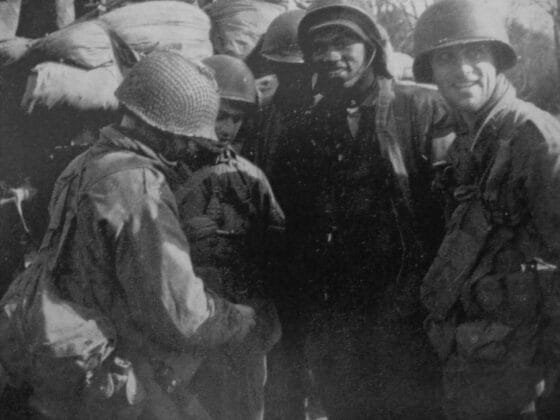
The liberation of northern Limburg in early March 1945 was largely down to one of three African-American battalions in the segregated US army. Many of the Black veterans kept quiet about their experiences during World War II, but their story has been slowly emerging.
The liberation of northern Limburg in the first week of March 1945 was the beginning of the end for Nazi Germany. Hitler’s hopes of one last offensive to drive back the advancing Allies had been defeated at the Battle of the Bulge, but the Siegfried Line remained a formidable barrier. Before they could tackle it, the Ninth US Army had to liberate a swathe of territory around Venlo, on the Dutch side of the River Maas.
After being held up for two weeks when the Germans broke the dams holding back the River Roer, the Americans advanced rapidly. On March 1 alone they liberated 15 Dutch settlements, including the key towns of Roermond and Venlo. The armoured vehicles of the 784th Tank Battalion rumbled through the streets, encountering little resistance.
An intelligence report on the fighting noted that “enemy materiel and organization of the terrain indicated that the enemy had planned an organized resistance but did not carry it out.” The tanks charged on, moving north towards Gelderland, where they joined British and Canadian troops preparing to cross the Rhine.
Yet many of the veterans of the 784th Tank Battalion kept silent about their part in liberating Europe for decades afterwards. Part of the reason was the racism they encountered in military service and when they went back home. The 784th was one of three African-American battalions in the US army, along with the 758th, formed in 1941, and the 761st, known as the Black Panthers after their unit insignia, a panther’s head.
For many people in Limburg it was the first time they had ever seen a black person. Els Claes, now 90 years old, remembers with crystal clarity how she was stopped dead in her tracks when, as a nine-year-old girl in the village of Steyl, she encountered an American soldier polishing his rifle. “I was struck dumb,” she says. “All I could do was look at the man. He wanted to give me something, but I didn’t dare go over and take it. I’d never seen someone so jet black.”
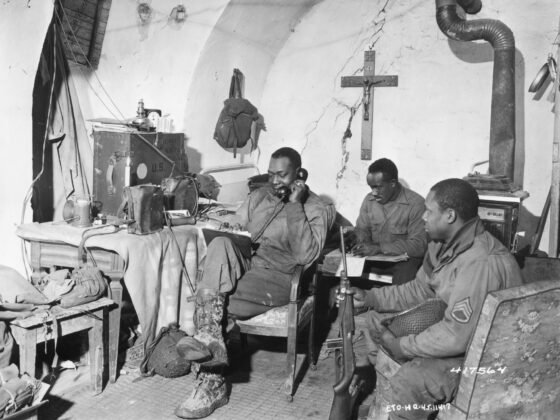
Black and white soldiers were not allowed to serve in the same units under Department of War rules. The Black battalions were under the command of white senior officers who slept and ate in separate quarters, even on the ship that took them across the Atlantic in November 1944. And when they returned to the United States after serving with distinction in Europe, it was to a country where the Jim Crow laws still held sway and black men were seen as anything but heroes.
Jim Crow laws
Congress had passed the Servicemen’s Readjustment Act in 1944, better known as the GI Bill, to give returning soldiers the chance of an education, but for many veterans in the south it ran up against the hard reality of segregation. Lynne Hamilton-Jones says her father, James Baldwin Hamilton, returned to his home town of Baltimore in 1946, three years after being drafted as a 19-year-old to serve in the 784th Tank Battalion.
“He came back to more racism and being limited in what he could do,” Lynne says. “He’d only finished high school, he didn’t have much money, he didn’t have any benefits from his service at all. No recognition for what he did, no awards, nothing. He got off the boat in New York Harbor, went back to Baltimore and had to start looking for jobs. That was it.”
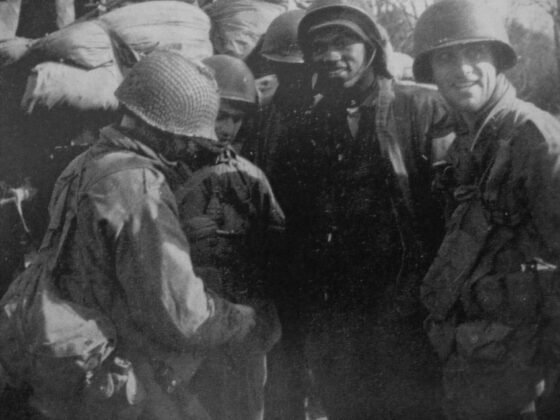
Her father only began talking about his service in the late 1970s. “I was a senior in high school, and the only reason he told me was because I was trying to decide what to do and how to pay for school. He said: ‘Why don’t you go in the military?’ and I said: ‘Why would I do that?’ And he said: ‘I think it’s a great thing to do, I served in the military in World War II.’ I had to back up because it was the first time I’d heard about it.”
Lynne obtained a military scholarship to Virginia Tech university and went on to serve in the US Air Force, rising to the rank of colonel. Her father pinned rank on her at her last promotion in 2006, two years before he died.
After joining the armed forces she began researching his history, but she had almost nothing to go on: James had no photographs of his time with the 784th and his uniform had been stolen in a break-in at his apartment. Some 80% of the army’s wartime records had been lost in a fire at the archives in Missouri in 1973.
Her father started to talk in more detail in the late 1990s after he was contacted by the war historian Joe Wilson, who wrote the definitive history of the Black Panther battalion.
“He talked about approaching Venlo in March 1945, and he said: ‘We were going so fast’,” Lynne recalls. “The Germans were taken by surprise. They didn’t put up a fight.” The biggest horror came when the battalion reached a camp where prisoners of war were being held, she says. “To see the gates opening and people coming out and literally falling dead. He said: ‘I saw what I thought were white sheets hanging, but they were bodies.’”
Reunion in Washington
Through Joe Wilson, Lynne arranged for her father to meet one of his old comrades from the 784th, Bill Hughes, in Washington, DC, in 2004. She recalls how the two men’s faces lit up when they came face to face for the first time in nearly 60 years.
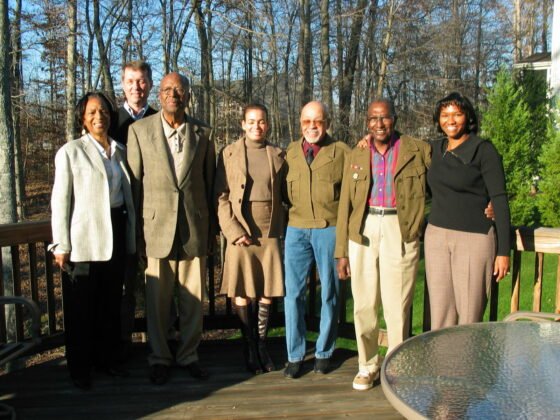
“I was just blown away,” she says. “We took them to the World War II memorial that day and they were just so appreciative of being able to enjoy that together and seeing that there was recognition of what they did.” They met again at a reunion at Lynne’s home two years later, a few months before her promotion.
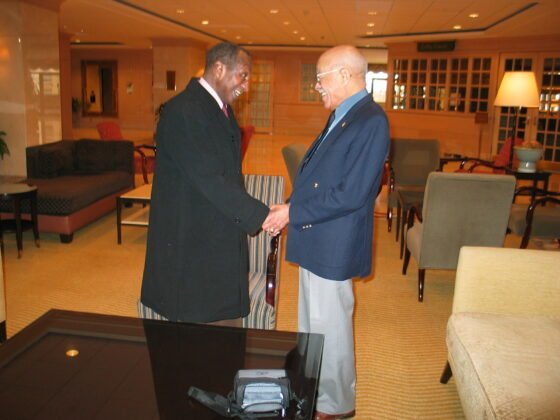
Bill Hughes came from Indianapolis and, like James Hamilton, rarely talked about the war while his children were growing up. His son, Max, believes it was partly a way of shielding his family from the horrors he had seen. “He probably didn’t want to go through the pain and he didn’t want to burden the kids,” says Max. “But as he got older, and especially after Joe Wilson’s book came out, I was able to talk with him about it on a different level.”
Unlike James, Bill stayed in Europe after the war. He met his German wife, Edelgard, in an art gallery in Frankfurt and lived in Germany for the rest of his life, raising five children and working for the US Department of Defense in a civilian role. “Segregation and racism was one of the reasons my dad said he wasn’t going back,” Max says. “He came from Indianapolis and he said when he was a kid he was going to get as far away from that place as possible.”
Late recognition
It took until the 1990s for historians in both the US and the Netherlands to uncover the significance of the Black battalions. Wilson’s history was published in 1999, while in the Netherlands, the work of Mieke Kirkels, who published three books between 2009 and 2017, led to the establishment of the Black Liberators foundation in 2009.
Kirkels interviewed dozens of surviving servicemen and Limburgers who recalled them coming to drive the Germans out of their towns and villages. Two researchers, Sebastiaan Vonk and Maarten Vleeming, identified 172 African Americans buried at the US military cemetery in Margraten from the race codes on burial certificates: code 2 denoted a Black soldier. One of the men Kirkels spoke to was Jefferson Wiggins, who as a 19-year-old sergeant dug the graves of his fallen comrades in Limburg.
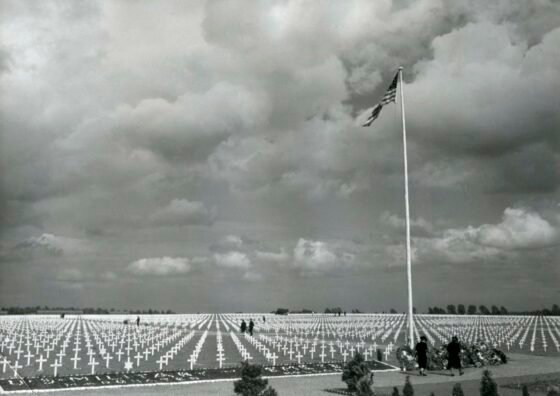
At the request of Kirkels and other Dutch historians, a panel featuring a quote by Wiggins, highlighting how American soldiers were fighting on two fronts, was installed in Margraten.
Last year the American Battle Monuments Commission, which runs the cemetery, ordered the panel to be removed, arguing that Wiggins’ words did not fit with its “commemorative mission.” The agency had reviewed its displays in the wake of a directive by the Trump administration to remove references to racial discrimination from museums and historical monuments.
Black American servicemen faced racism from the moment they reported for training at Camp Claiborne, Lousiana, where they were subjected to discrimination by military policemen and bus drivers. They stayed out of town to avoid being assaulted by locals. One of the 761st’s star recruits, the baseball player Jackie Robinson, never saw action because he was court-martialled for refusing to sit at the back of a segregated army bus.
Peeling potatoes
General George S. Patton gave a stirring speech to the Black Panthers after they landed in Europe, telling them: “I don’t care what colour you are as long as you go up there and kill those Kraut sonsofbitches.” But in private, as Joe Wilson recounts, Patton doubted the Black soldiers’ suitability for combat: “They gave a good first impression, but I have no faith in the inherent fighting ability of the race.”
As a result, trained soldiers were often given menial tasks by officers who were reluctant to put them in the firing line. Lynne Hamilton-Jones says: “I remember my father talking about how they’d have him peeling potatoes when he was trained to repair tanks and machinery. That kind of stuff just makes you shake your head and think: you can’t be that dumb.”
President Harry S Truman formally abolished segregation in the armed forces in 1948, but what did for it in practice was the brutal logic of war. The US army lost 16,300 soldiers in the first six weeks of the Normandy campaign after D-Day, and liberated just 20 miles of French territory. If the breakthroughs were to come, it needed all the manpower it could get. Patton sent in the 761st and 784th Tank Battalions and they proved to be some of the most effective fighting machines on the western front.
James Hamilton never expressed any bitterness about his wartime experiences. The bonds he forged with his fellow soldiers were stronger than the formal strictures of segregation, says his daughter Lynne. “He spoke so highly of the people he served with, the way they took care of each other. If he couldn’t go into a particular area where they ate, the soldiers working on the white side would make sure they found food for them.”
“Always a fighter”
Jefferson Wiggins also recalled, when he visited Margraten in 2009, that any resentment he felt about racism had to be put aside during the gruelling 12-hour shifts to bury “those we could not even associate with in life”.
By then he was one of the last few surviving members of the 960th Quartermaster Service Company that dug the graves. “We realised that whatever life experiences we’d had as African Americans, this was our obligation – to set aside our prejudices, our colours, and our fears, and give to these young Americans the honour, the respect, and the dignity they so well deserved,” he said.
Max Hughes says his father would have recognised the sentiment that American soldiers were fighting on two fronts. “He was always a fighter,” he says. “He said, ‘I’m not going to let the system get me down.’ By not going back to the States he didn’t have to fight for civil rights as strongly as if he’d been in America.”
Bill Hughes’s loyalty to the army he served with never wavered: he returned to Limburg to meet up with his fellow veterans every year until he died in 2013. Max says: “He was patriotic, because of his history of fighting in the war, but he never said he was proud to be an American. He never said America is the best or the greatest or anything like that. But when he passed away he wanted to be buried with military honours. That was important to him.”
Ignoring the battle against segregation diminishes the sacrifice and bravery of those who fought it, Max argues. “It’s important that history is documented the way it was. To leave it out is not only a disservice to the people who put their lives on the line, it’s erasing parts of history. The question I always ask myself is: why? What kind of small-minded feudal energy is behind that? What are you afraid of?”