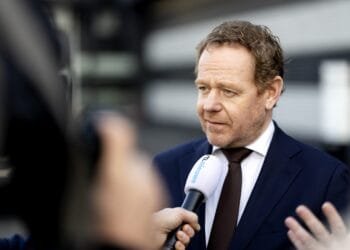
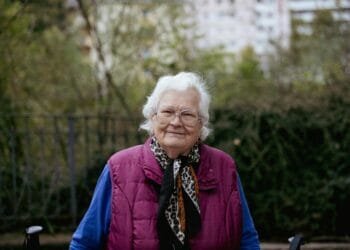

Originally from Yorkshire in England, Gillian Vogelsang-Eastwood moved to the Netherlands after falling in love with a Dutchman 40 years ago. She’s now the director of Leiden’s Textile Research Centre, says she feels like a visitor when she visits England and is fascinated by silent Dutch water.
How did you end up in the Netherlands?
I married a Dutchman named Willem. We met on the 2nd of October in 1983 at a dinner party in Cambridge. A friend of mine rang up to say that all the guests coming were Dutch and asked if I could come as a representative of the Anglo-Saxons.
We were both grad students at the time and would go on to become archaeologists. Our studies and projects took us to different corners of the world, so we corresponded with letters and phone calls. I was in Chicago followed by Egypt, but he was in Belgium. Despite all this distance, it just felt comfortable.
It got all the more complicated in 1985. I have three sisters. My eldest sister, who was in Australia, decided she was going to get married in the village where we were brought up. That led to three weddings in six weeks to make sure all of the sisters could attend all of the weddings.
My eldest sister married an Australian, I went Dutch, and my younger sister married someone who was Polish-German. The local newspaper ran the headline: “Eldwick sisters go international.” Then it became a question of who would get the first job, myself or Willem. He did, so we moved to the Netherlands.
How do you describe yourself – an expat, lovepat, immigrant, international?
A neither/nor because I’m no longer English and I’m not Dutch. I’m a bit of everything. I’m comfortable living in the Netherlands. I have no problem with it. Occasionally, it flummoxes me, but I’m okay with that.
When I go to England now, because I’ve been out for 40 years, I’m a visitor. When I speak with my family, half the time I have no idea what they’re talking about. Local politics, this happened and that happened. It bypasses me, so that’s why I say I’m a neither/nor.
I float between various worlds and I’m quite comfortable doing that.
How long do you plan to stay?
Because of now having children and grandchildren, we intend to stay here permanently. I have been asked if something were to happen to my husband if I would return to England but the answer is no, because my family is now here.
It’s a very convenient, easy-to-live-in country.
Do you speak Dutch and how did you learn?
I do speak Dutch and with a very good English accent that will never leave. I have no problem with day to day things. More specific things, like the law and finances, I prefer to have someone with me just to make sure I know what’s happening.
Most people are very surprised that I speak Dutch and the Dutch often automatically start off in English with me, but we soon get over that. I began by talking with my husband and moved on to courses run by Leiden University. Listening to the television also helped, especially the news.
Some of Willem’s family also could not speak English at all. They were of a different generation, so I had to learn pretty basic Dutch quickly for them.
I was talking with Willem about this and we tried to recall the first phrases I learned in Dutch. One was ‘geen melk, alstublieft’ because I’m allergic to cow’s milk. The other was “mierenneuken” [literally, have sex with ants, but meaning nit-picking].
What’s your favourite Dutch thing?
Having lived here for so long, I’m no longer sure. I do like just how easy it is to live here, especially when you see what’s happening in the world in general. I used to work a lot in the Middle East. Given what’s happening there, I’m genuinely grateful we live here.
People here are friendly, they’re willing to listen, and they’re willing to compromise. Even if they say “no”, you can sometimes say, “Okay, let’s talk about this. Why is it a no?” and build up on that. It’s not always a firm no, as it would be in many other European countries. It makes life easier.
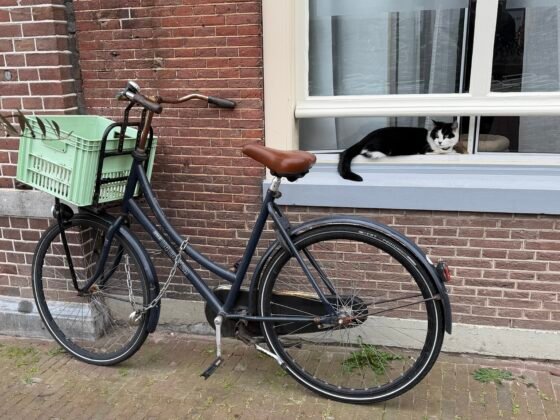
It’s also easier to get around. The bicycles, trains, and buses make it easier to avoid purchasing a car. We didn’t have one until five years ago. My husband retired and there were grandchildren, so that’s why we decided to get one.
How Dutch have you become?
I’m not Dutch. I never will be Dutch. I have a Dutch passport and that was done because of Brexit. It really irritated me, so I got Dutch nationality. Before then, I said it doesn’t matter. I could have a British passport, a Dutch passport, it made no difference.
So with Brexit, I decided on Dutch nationality. Will I ever be Dutch? No. Does my family want me to become Dutch? No. They want me to remain myself.
But my husband says I’m becoming more and more Dutch. I’m not quite sure how, though. If it has happened, it’s happened very, very gently and gradually. I’ve not really noticed it.
Which three Dutch people (dead or alive) would you most like to meet?
Because of the Textile Research Centre and the collection we have, there are three particular objects I’d like to know more about. I would like to meet the people who originally owned them.
The first object is a miniature hat – a guild examination hat, that dates back to 1796. It was owned by a man named Hendrik Visser. I want to know more about him, how he made it, what were his ideas, why he made it, and what happened to him and his family.
The second one, which comes from 1820, is a lace shawl owned by then-princess Anna Paulowna, who eventually became queen after marrying king William II. One of her ladies-in-waiting became pregnant, had a girl, and the princess gave the shawl to the baby. Now we have this piece with this history that was given to us by a very noble family in Wassenaar, but who was Anna?
And we have the diplomatic uniform of Laurens de Groot. He was a member of the Tweede Kamer in the 1920s and 1930s. Back then, parliamentarians had to wear semi-military uniforms complete with swords whenever there was an official event in The Hague. They were also very expensive.
Laurens gave the uniform to a friend who, after he was elected to parliament in the 1960s, couldn’t afford a new one. It’s beautiful, embroidered, with a hat, the sword, and everything.
What’s your top tourist tip?
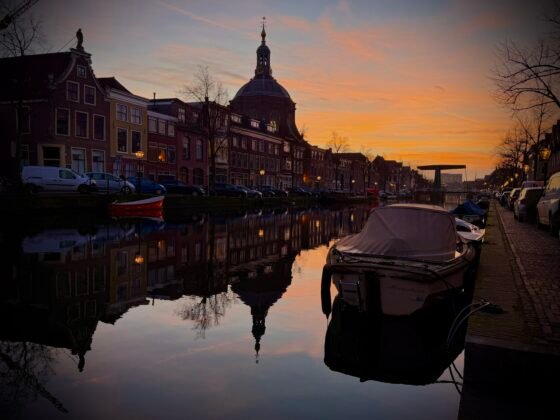
A walking tour of Leiden that includes a stop at the Burcht. Up there, you can look over the centre of the city. It’s a good starting point for Leiden’s history. They should make sure to come on a Saturday, so they can also go to the nearby market, which is many hundreds of years old and has been continuously there.
They should also go to a few of the churches and down some of the little back lanes. There’s much to learn, including how the canals were filled in and why they’re now digging up some of the roads to bring them back. Water is so important to Leiden and there’s the Rhine. Many people forget this is pretty much the river’s end point.
There’s also the university and the Hortus, one of the first botanical gardens in Europe. It’s still active. We have a living history here that can be enjoyed by just wandering around. Wherever you go in Leiden, there’s history.
Tell us something surprising you’ve found out about the Netherlands
How flat it is. I remember the first thing that really got to me about the Netherlands was that water here does not have a sound. I’m used to Yorkshire, where water flows. It’s fast, there’s lots of streams, and lots of stones, so it has a sound. Water here is flat. It moves, but at an incredibly slow pace. It has no sound.
If you had just 24 hours left in the Netherlands, what would you do?
Be with the grandchildren. We’d take them out to the Plasdijk, a nature area outside Leiden, and have a borrel with the family. Hopefully, it would be a summer day.
Gillian was speaking to Brandon Hartley.
You can purchase Gillian’s new book, The Atlas of World Embroidery: A Global Exploration of Heritage and Styles, in either English or Dutch. To learn more about her ongoing projects at the Textile Research Centre, be sure to visit its website.