


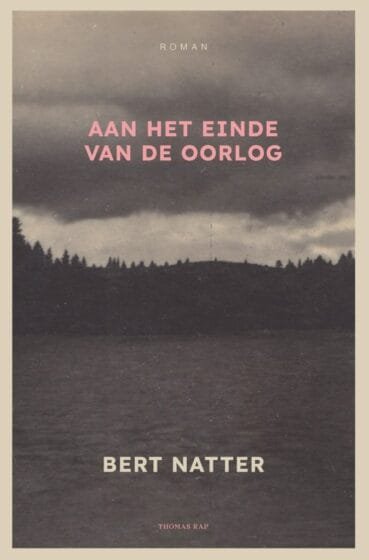
Bert Natter’s Aan het einde van de oorlog (At the end of the war) takes place over a single day: April 20 1945, Hitler’s 56th birthday, 10 days before his suicide, with the Red Army within earshot.
The novel is set in a fictional German concentration camp modelled on Ravensbrück, the largest women’s concentration camp in Nazi Germany. The deputy commandant’s 11-year-old son has gone missing. The reader works out what has happened to him before anyone in the book does.
The book won the Libris Literatuur Prijs, the Netherlands’ most prestigious fiction prize, this month. It is a bestseller in the Netherlands, with multiple translations throughout Europe in the works. The English version is pegged for 2028.
Chessboard
Natter had been thinking about the form for years. He wanted to do for the concentration camp what George Saunders did for Lincoln’s grief in Lincoln in the Bardo: tell one story through many voices that meet only on the page.
The idea came from Sarah Helm’s history of Ravensbrück, If This Is A Woman, where Natter found the story of an Auschwitz under-commandant transferred north in late 1944, whose children played in the camp wearing identifying medallions so the guards wouldn’t gas them.
“That was the beginning of my idea to write this novel. We call it a talisman, something that protects you. But it could turn into something on which the enemy would know you are the child of an SS officer. I thought: this is a novel.”
He called Helm’s history “one of the most gruesome books I ever read,” particularly disturbing for its account of “the violence of women against other women in Ravensbrück.”
The novel has 31 named figures: SS officers, prisoners, wives, children, a driver who pockets stolen goods, a nurse who watches a wound infect. Each occupies a square of the camp. The clock runs in real time across 24 hours.
“I could have made it 32,” he says of his 31 characters. “That’s how many pieces there are on a chessboard.” But the story is a sinister, asymmetrical human tale, not a game.
The writer and the civilian
The novel does not hold back. The disappearance of the commandant’s son is not a mystery the novel withholds for a final reveal – the reader understands early what has happened to him.
Once the commandant’s son has lost his would-be talisman and ended up inside a gas chamber, the momentum of what is coming builds over ten consecutive scenes.
As this happens, we cross-cut to scenes of lavish sexual violence elsewhere in the camp. The lines between victims, perpetrators and bystanders blur and shift, with each player largely blind to their own significance or the consequences of their actions.
“The writer in me is sometimes separated from the person, the civilian,” Natter said. “As a person I find it difficult to write about this kind of violence. But when I look at it as a writer, I just look at it quite technically.”
Not the sadists
One shadow over the novel is Hannah Arendt’s idea of “the banality of evil,” coined in her 1963 book about the Eichmann trial. Natter drew a careful distinction from this idea.
“Eichmann is the prototype of the desk murderer,” he says – ordering killings on paper from a comfortable distance. “I wanted to have a main character, Karl Zehlendorf, who isn’t that kind of bad guy – but who really is someone who murders and rapes and has blood on his hands.”
Karl considers himself a decent man – a musician, planning a post-war career as a concert pianist. “This book is not a lesson,” Natter says, “but there are lessons to be told. Most people see themselves as decent people. It’s not the sadists that make the concentration camp work. It’s the decent people. And that’s the banality of evil. Look at yourself.”
The system, not the spectator
That last instruction – look at yourself – is also where Natter parts company with his critics. Dutch reviewers have pushed for contemporary political parallels, pressing him to comment on the rise of far-right movements throughout the West and on recent atrocities and genocides. He has pushed back on these comparisons.
“It’s not difficult to say that Gaza is a genocide,” he said. “I stand up against that from Baarn, Holland – a poster on the wall, whatever. But that’s not the kind of decency this is about. This is about when you’re a citizen of Russia and Russia is attacking Ukraine. What do you do? These people are trapped in this system.”
The hard moral question in the book is not for the international reader denouncing atrocities elsewhere from a safe country, he continued. It is for the people inside the regime – for the driver who picks up the talisman tag without asking where it came from, for the nurse who watches the wound infect, for everyone who doesn’t ask.
That is why the small acts of refusal in the book cost everything. A Jewish tubist who plays a few bars of the Internationale instead of the assigned march is shot in the neck. Natter pairs that with a wartime Amsterdam story: a passenger who whistled It’s a Long Way to Tipperary on a tram was overheard, arrested, and sent to Kamp Amersfoort.
Dutch traces
Nowhere in occupied western Europe did a higher proportion of Jews die than in the Netherlands (roughly three in four).
The book’s Dutch traces, however, are subtly woven into the plot.
A character called Suzie de Bruin – a member of the Raad van Verzet, the Dutch armed resistance – sorts through bloodied Wehrmacht uniforms in the camp’s plunder warehouse. Her colleague has been at Kamp Amersfoort. That trace is what survives of the novel Natter spent five years on before abandoning it for this one.
Natter said he didn’t know exactly what would happen to the characters after he first created them: “When I put these pieces on the chessboard, I know how it’s going to end, but I don’t really know how I would get there.”
“At the end of the day, I just wanted to write a really good book.”