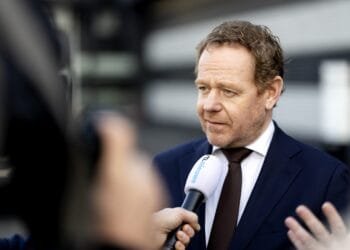



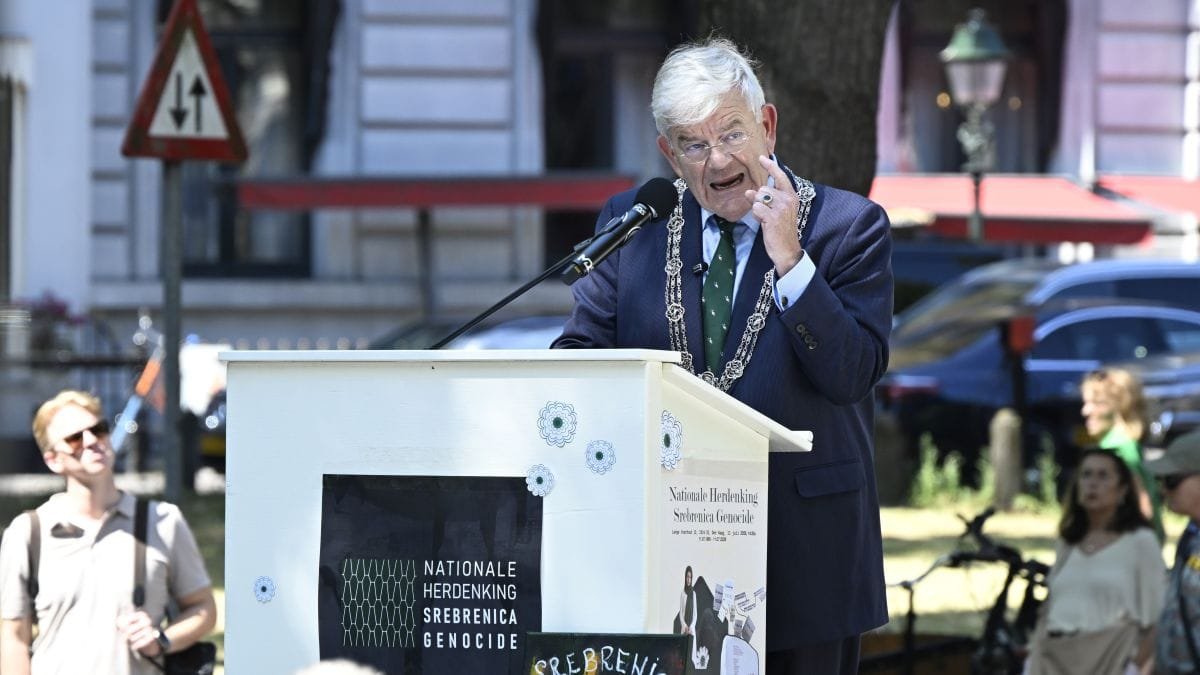
Commemorations marking 31 years since the Srebrenica genocide were held in The Hague on Saturday, where mayor Jan van Zanen used his speech on the Lange Voorhout to speak of Hanna, a girl who plays hockey in a jersey with the number 11 to commemorate her grandfather and other victims of Europe’s largest genocide since the Second World War.
Alma, Hanna’s mother, was just 14 years old when her father was murdered in Srebrenica in July 1995.
He was one of some 8,000 Muslim men and boys who were slaughtered during one week in July after Bosnian Serb troops led by General Ratko Mladić overran what was supposed to be a UN safe haven under the protection of UN peacekeepers.
July 11 is the anniversary of the takeover of Srebrenica, something Hanna still has to explain often. Van Zanen said he finds that shocking.
“Because the stories of the dead and their relatives, and of all the others who ended up in the hell of Srebrenica, should be an inseparable part of our collective consciousness.”
Dutch soul searching
What happened in Srebrenica has weighed heavily on the Dutch. The peacekeepers who were on watch saw Mladić separate the men and boys from the women to bus them to several nearby killing fields, and officers threw hundreds of Bosnian men off the Dutch base in Potočari to waiting Bosnian Serb forces. The nation has grappled with annual soul searching ever since.
The Dutch government collapsed in 2002 over the issue, with then prime minister Wim Kok saying that although the Netherlands didn’t accept legal responsibility for the massacres, he would take political responsibility.
And in 2011, a Dutch appeals court held the state liable for the deaths of three men forced off the compound, and paid reparations to their families, including the son of compound electrician Rizo Mustafić, who had been battling the Dutch state for almost a decade. “I am very happy, finally,” Mustafić said at the time. “It feels great. I’m going to bury my dad July 11 and this is so good.”
Every July 11, relatives of those who were killed have the opportunity to bury the remains of their loved ones, even if it’s just a bone. This year was no exception, with ten people being buried. An estimated 900-1,000 people are still missing, lying in mass graves that have been removed, moved or ploughed over.
Monument
“For me, commemorating also means that we continue to pass on the names and stories of the individual victims,” said Samir Hajdarević, chairman of the National Monument Srebrenica Genocide, this commemoration. He came to the Netherlands from Bosnia at the age of nine.
“As long as we speak about them, they are not reduced to a number in a history book. On the one hand, there is much grief, but there is also much responsibility.”
This year’s commemoration, which was attended by hundreds, focused on the mothers of Srebrenica, who organisers say play a key role in “the active culture of remembrance”.
In The Hague, a monument dedicated to the Srebrenica victims will be erected on the site of the former Yugoslav war crimes Tribunal, where the 31st piece of natural stone was placed this weekend. “One stone for every year that separates us from the genocide,” said the mayor.
Former general Ratko Mladić, the man sentenced to life in prison for the genocide by the tribunal where it will be commemorated, remains in jail.