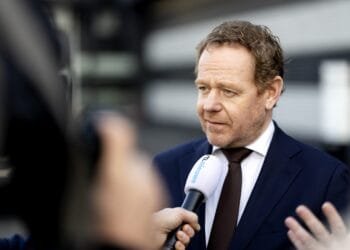


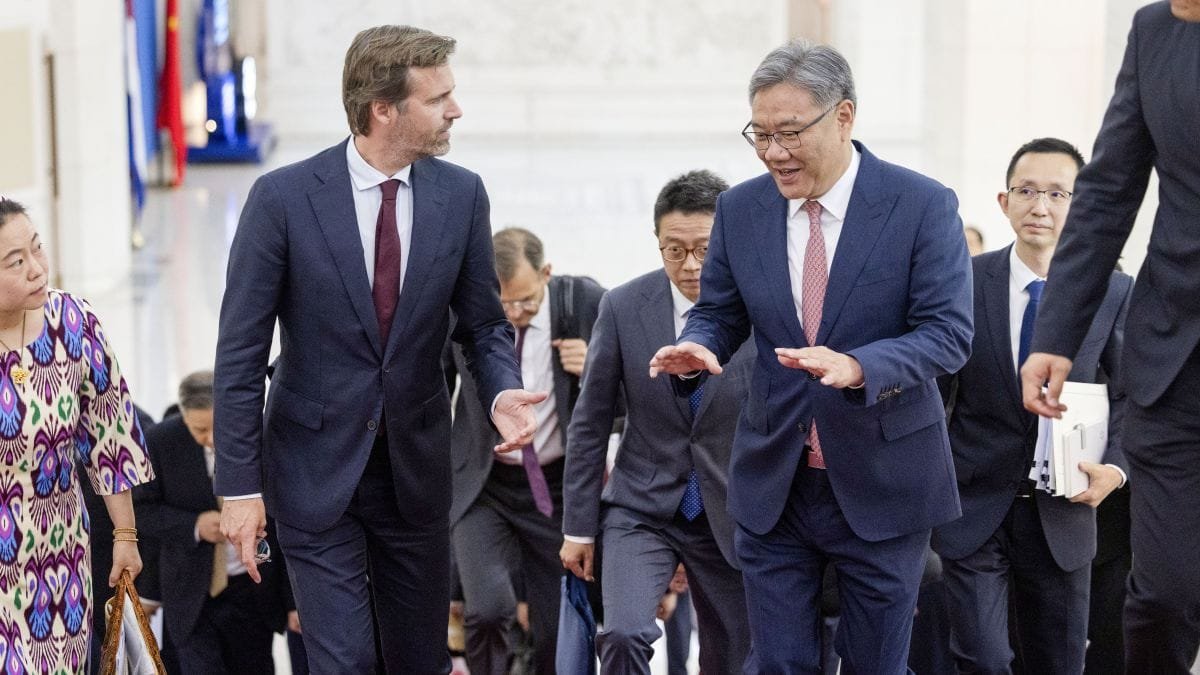
Foreign trade minister Sjoerd Sjoerdsma, who was personally blacklisted by Beijing five years ago, has arrived in China at the head of a small business delegation, hoping to repair relations with the country after disputes over microchips.
Sjoerd Sjoerdsma, of the centrist social-liberal D66, began a three-day visit to Beijing and Shanghai on Tuesday accompanied by 17 companies working in logistics, agriculture and high-tech.
It was the first ministerial-level trade mission to China since 2018, when 165 Dutch firms made the trip. Sjoerdsma said relations had come under unnecessary strain since then, in part because of the government’s intervention in Nexperia.
Chips and Nexperia
Nexperia, a Nijmegen-based chipmaker owned by China’s Wingtech, was placed under Dutch state control last September, prompting Beijing to halt exports of its China-made chips and leaving European carmakers short of supplies. The row has since cooled, though the case remains before the Amsterdam courts.
Chip machinery maker ASML, the Netherlands’ most valuable company, has sent representatives with the minister. Sjoerdsma has been fighting a proposed US law that would let Washington block ASML from selling and servicing some machines in China.
On the first day the two sides signed a letter of intent to establish a China-Netherlands Business Council to encourage trade and investment. Bilateral trade was worth around €90 billion in 2024, according to news agency ANP.
Sjoerdsma said the EU’s trade deficit with China was one of the biggest sticking points, with Chinese exports to Europe last year running nearly €1 billion a day ahead of imports. That was “something we cannot tolerate,” he said, NOS reported.
China’s demands
Dutch companies used the visit to put their concerns to Chinese commerce minister Wang Wentao, but Chinese firms came with a wish list of their own.
Yangzhou Yangjie Electronic Technology, which supplies chips to Europe’s car industry, was added to the EU’s sanctions list in late April after its products were found in Russian drones and glide bombs.
Brussels has since proposed a nine-month suspension to avoid worsening the shortage left by the Nexperia dispute, and the company pushed Sjoerdsma to back it.
Nuctech, a Chinese maker of scanners used at European ports, asked Sjoerdsma to lift restrictions it faces. Its Rotterdam office was raided by the European Commission in 2024 over suspected illegal state subsidies, and it has long been dogged by espionage concerns.
Human rights and trade war concerns
China placed Sjoerdsma on its own sanctions list in 2021, when as an MP he described the treatment of the Uyghurs as genocide. Asked whether he stood by that, he said his concerns “have not gone away,” but that he was now travelling as a minister.
He pointed to a new EU law banning goods made with forced labour from the European market, arguing it gave China an incentive to act.
Much of the friction is now with the EU, Sjoerdsma said, adding that he was in close contact with EU trade commissioner Maroš Šefčovič. Brussels and Beijing have given themselves until October to settle a series of disputes.
Wang said China wanted to avoid a conflict and was willing to tackle subsidies and overcapacity – but “according to our own rules,” broadcaster NOS reported.