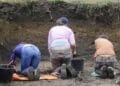



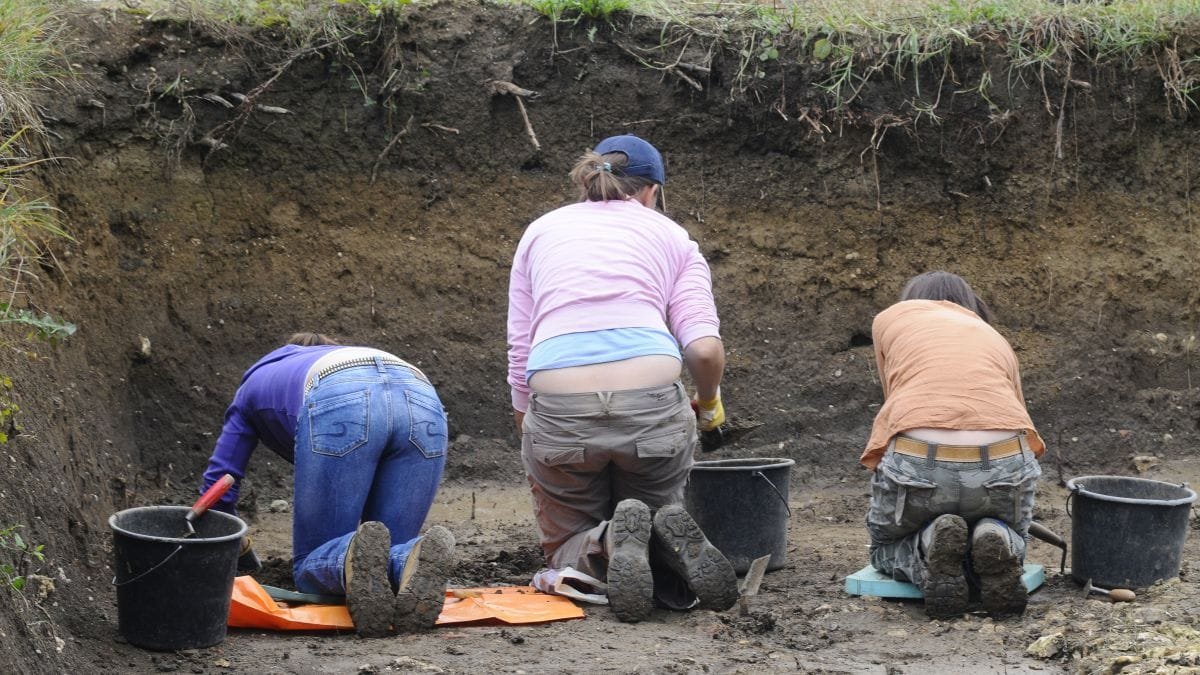
A field near Holthone in Overijssel has turned into a military camp this week, with rows of tents and camp beds. The people sleeping in them are not soldiers, though, but archaeologists and military veterans – and they are there to dig up a battle fought 800 years ago.
They are carrying out the first scientific study of the Battle of Ane, a bloody clash in 1227 between the bishop of Utrecht’s army and farmers from Drenthe, NOS reported from the site.
Against the odds, the farmers won. The story is still told in the area, said Jos Stöver, a heritage specialist at the Cultural Heritage Agency (RCE). “There is even a monument to it,” he said. “The feeling is: we beat the high and mighty from Utrecht.”
A battle in the bog
The roots of the fight lay in a dispute over taxes and power: the people of Drenthe wanted more freedom, while Bishop Otto II of Lippe wanted to cement his power. On July 28, 1227, his knights met a farmers’ army led by Rudolf van Coevorden on marshy ground near present-day Ane, between Hardenberg and Coevorden.
The bishop’s force was larger and more professional, but the landscape undid it, said historian Bert Finke. “The field looked green, but underneath it was boggy,” he said. The heavily armoured knights and their horses sank into the mud, and the lightly armed farmers cut them down. The bishop and many of his men were killed.
Otto’s death prompted a papal-backed crusade against the Drenthers – branded heretics for defying their bishop – and Van Coevorden was later seized during a truce at Hardenberg and executed.
Coins, bolts and a rare find
Much about the battle is still unknown, including exactly where it began – part of what drew the researchers to the site. The RCE and a local military-history foundation decided to examine the battlefield systematically ahead of the 800th anniversary next year, in what the agency says is the first study of a medieval battlefield in the Netherlands.
So far the metal detectors have mostly turned up coins and scraps of iron from the past two centuries, much like a recent haul in neighbouring Drenthe, but the team hopes digging deeper will bring medieval material to the surface.
One object already has them excited. A volunteer, Jurrien Toenhake, found a small metal piece near the site in 1990 and thought little of it – until a detector salesman in Lutten recognised it two years ago as a pommel, the knob at the top of a sword or dagger grip.
Experts say it is unusual the world over: most pommels come from swords, while this one, dated to around 1195 and bearing a noble family’s coat of arms, came from a dagger. It may well have been used at Ane. Toenhake would like to see it in a museum.
Familiar terrain
The 15 former soldiers combing the field came through Recovery on the Battlefield (ROTB), a foundation that supports veterans living with PTSD or physical injuries, RTV Oost reported.
“Battlefield archaeology matters because, for veterans, this is familiar terrain,” said the foundation’s chairman, Corstiaan de Haan, who served in Bosnia. The participants span different generations and served in different countries, and the work draws them out. “A conversation comes more easily than in a formal setting,” he said.
The army supplied the tents, which was hard for some to see at first, De Haan said – but once the camp was up, the mood lifted. Eight centuries on, the marsh that swallowed a bishop’s army has become, for a week, a quiet and companionable place.