

Robine Rijke struggles to remember the first time she watched a televised game of cricket.
“You couldn’t really watch it online back in the day but I recall heading to my local cricket club to watch the men’s side play the 2009 World Cup [in England].”
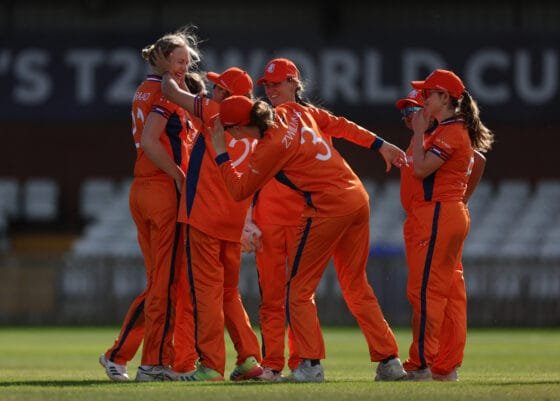
Fast forward 17 years and she is now part of a squad that is now in its first-ever T20 World Cup in England and Wales, with all matches on free-to-air TV in the Netherlands.
Rijke is one of the four Dutch batters to have scored over a thousand runs in T20Is, alongside captain Babette de Leede, Sterre Kalis and opener Heather Siegers. Wednesday will see the team’s biggest challenge ever, against India.
It is no mean feat considering she is one of the rare cricketers to have no sporting background and only picked up the sport by chance when her brother’s football club in the Hague were handing out flyers for an introduction day.
Factor in the fact that she works a 9-to-5 job with the Netherlands Gambling Authority, and is currently here on unpaid leave.
“It is quite challenging to combine full-time work with full-time cricket,” she said, sitting in a Nottingham cafe, still coming to terms with what the next few weeks could hold.
“We have multiple training and fitness sessions throughout the week, club cricket on the weekends, and I also play hockey.
“After we qualified for the World Cup in Nepal this past January, I was back in the office the morning after we landed.
“My work is thankfully very supportive. Sometimes I go to work and straight to the gym after or train in the morning and then do a fitness session in the evening. Everywhere I go I’m packed with five bags!”
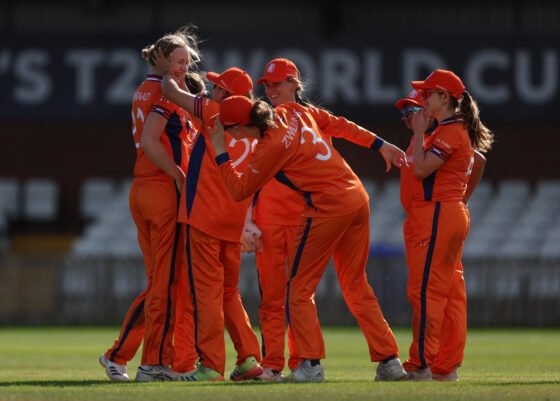
Apart from De Leede, who lives in Cape Town and plays for Western Province, and Kalis, who is contracted with Yorkshire, none of the players are full-time professionals.
Leg-spinner Caroline de Lange worked at the neurology department at a hospital in Gouda and recently quit her job to be able to play at the World Cup.
“It was a tough job. People would come in with strokes and seizures and I would be the main doctor on the shift giving instructions. Sometimes, I would get five calls in between that so it was pretty crazy to be fair,” De Lange said.
“Last summer, I had to captain a club game final straight after a night shift (laughs).”
Most of the players are either still at university or finishing high school. Frédérique Overdijk, who is training to be a dentist, left a preparatory training camp in Scotland for two days to take a final exam, and is set to take the No. 7 spot as an off-spinning all-rounder.
“There was a time when we had to pay to go on tours, we trained in sports halls without cricket nets for years and did not have a physio travel with us. We came from nothing and now we train almost every day of the week and have a full-time coach,” Rijke said.
Winning, then, becomes all the more significant with the prospect of professional contracts on the horizon. All 12 participating teams will earn an assured minimum prize pot of USD 247,500, while every group match win will earn them USD 31,154.
But results are still secondary.
“It’s so empowering that women’s sports is growing but we also went through all those years where people at our clubs were like, ‘oh, women’s cricket is shit’. Now, we can be proud of our achievements having proved people wrong,” Rijke adds.
“We want to set an example for more youth girls to follow in our footsteps because it’s always been hockey and football and that’s kind of been it.”
From sports halls to Headingley
The next few weeks could be a defining period for the sport. Having lost their opening game against heavyweight Bangladesh, India is next, followed by Australia, South Africa and Pakistan.
The World Cup will be free-to-air with Dutch commentary on public broadcaster NOS with the ICC, the sport’s governing body, also broadcasting all the games live on YouTube.
“We got exactly what we wanted in terms of some intense match practice in some challenging weather conditions with rain delays and some strong winds,” said head coach Neil MacRae, who has been instrumental over the last two years in instilling a smarter approach and helping organise regular cricket tours to the UK.
The tournament is MacRae’s last at the helm, having been brought on-board on a “two-year project” in his first-ever coaching gig with a women’s team.
“I’m not pretending two years ago I had any real idea about women’s cricket, obviously it’s still cricket, but some of the requirements to coach a women’s team, in terms of communication, understanding group dynamics, understanding the way women’s cricket is played, I really have to thank the players for teaching me that.”
“They’re a group of Dutch women who are not shy about telling you what they think, so they’re very Dutch, very direct. I’ve actually really enjoyed that, because they’ll tell you what they think, and we can move forward quickly, whether it’s good or bad.
“I was just here to help them fight every corner in terms of the challenges they’ve got, and the project that they wanted to go on. They’ve done it off the pitch, and they now deserve their place in the World Cup.”
Fixtures (all times in CEST):
Wednesday, June 17 3:30pm vs India
Saturday, June 20 11:30am vs Australia
Thursday, June 25 7:30pm vs South Africa
Saturday, June 27 11:30am vs Pakistan