


The left-wing alliance of GroenLinks-PvdA is expected to stay in charge of Amsterdam city council after this week’s local elections after opening up a gap on third-placed D66 in the final opinion poll.
The survey by O&S for local media outlets Het Parool and AT5 put the Labour party (PvdA) on 17.6% of the vote with GroenLinks on 15.2%.
The two parties are standing separately but will merge later this year following a vote by their members.
The progressive-liberal D66 has lost ground in third place as some voters on the left who backed the party in last year’s general election have become disillusioned with the centre-right coalition formed by national party leader Rob Jetten.
However, the three parties are still projected to win 24 seats between them, which would enable them to continue with the coalition that has run Amsterdam city council since 2018.
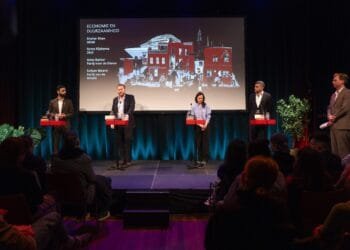
In the final debate before polling day, GroenLinks leader Zita Pels said the party’s campaign had been “unashamedly left-wing”, targeting rogue landlords whom she blames for driving up rents and exploiting the housing shortage.
Pels, who is currently alderman for housing, said the city had helped 50,000 households install better insulation and wanted to keep improving sustainability.
Tourist tax
Angelo Delsen of the Socialist Party (SP) called for the tourist tax to be quadrupled to pay for free public transport to alleviate the growing income gap in the capital.
VVD leader Daan Wijnants asked why the parties were not discussing vital issues such as rubbish collections, while Sytzke Rijpkema of far-right party JA21 claimed well-off Amsterdammers were being driven out of the city.
He said the city should be trying to improve conditions for the poor rather than squeezing the rich, but he added: “If people don’t want to learn the language, maybe we need to use a stick.”
Stop and search
In Rotterdam, parties clashed in the final debate on public safety and the issue of whether police should use stop and search powers more widely to prevent street crime.
Left-wing party BIJ1 said more stop and search would lead to ethnic profiling and damage relations with minority communities. “We need to end the culture of repression and control,” said Denk candidate Tikhoe Isaak.
Sjef Siemons of pensioners’ party 50Plus claimed preventive searches had been effective in taking knives and other weapons off the streets, while Rene Segers, of the centre-right Christian Democrats (CDA), said it should only be used at specific times and places. “That’s what the police themselves say,” he said.
Local parties strong
Rotterdam is expected to be a tight contest, with local right-wing party Leefbaar Rotterdam expected to take around 21% of the vote while GroenLinks-PvdA will win 17%. D66 is projected to take 9%, according to a poll by Maurice de Hond.
The last pre-election poll in The Hague indicates that the local party Hart voor Den Haag, led by Richard de Mos, could win as many as 14 of the 45 seats on the council, with PvdA-GroenLinks and D66 in a contest for second place with eight or nine seats.
The main losers in both Rotterdam and The Hague are likely to be the right-wing liberal VVD, who are in a coalition with D66 and the CDA in the national government. But the largest share of votes nationwide is expected to go to local parties, with around 35% of the total.