

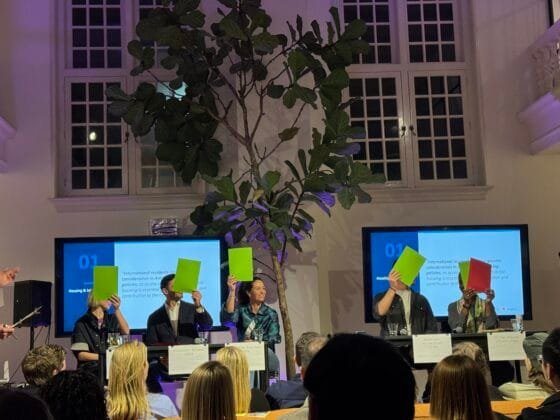
“In recent years, internationals have been blamed for more and more of the city’s problems – in the press, by Amsterdammers in the street, and also by some of the politicians,” said one Amsterdammer. “What are your parties going to commit to do about it?”
At the only debate for international voters in the Dutch capital, some of the audience felt the words said on this podium did not always match what their political colleagues said and did in council meetings.
While Dutch political parties across the country are taking a friendly tone to foreigners who can vote in local elections on March 18, one tension was clear on Monday night: many foreigners speak enough Dutch to follow council debates and read the local papers.
“In Amsterdam but also in the Netherlands, when it comes to certain parties, they’re always looking for a scapegoat,” agreed the head of the liberal Volt party, Juliet Broersen. “Doesn’t matter who it is, refugees or internationals, when they have a scapegoat, they’re fine, because they need someone to blame. And that is something that we’ve been fighting against for the last four years.”
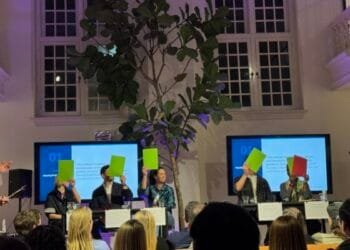
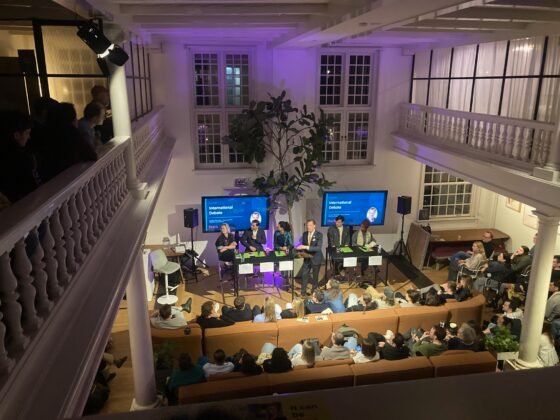
In the sold-out debate, organised by IamExpat, Dutch News and the D66 Amsterdam, five parties did their best to tell a room representing 130,000 international voters that they were the immigrant’s best friend.
The heads of the largest parties declined the foreign invitation and instead attended a debate organised by the Jewish community. But incumbent parties PvdA, GroenLinks and D66, plus the centre-right VVD and pro-European Volt told 300 people they wanted to do more for “international” Amsterdammers.
All of the speakers had lived, studied or worked in other countries and said they understood the challenges of living without a support network, being exposed to exploitation on the housing market and struggling with a different language.
“How many of you are going to change your answer when you’re speaking for a Dutch audience?” asked host and comedian Greg Shapiro pointedly at the start.
Find out more about what the parties think in Amsterdam
Volt – admitted Milka Yemane from the green left GroenLinks – had consistently stood up for Amsterdam’s international population. “It was our party that really focused on making sure that internationals knew that they have the right to vote, for example,” said Broersen.
“It’s really about [making] democratisation and participation available in English as well…to really show this is a diverse city and we need to treat it that way. Whether it’s in a city or at an office, on the work floor, or in policy, a diverse group makes better outcomes.”
Tolerance
D66, prime minister Rob Jetten’s party, last year made a public plea to avoid scapegoating internationals for the Amsterdam housing shortage. It said it wants to stimulate more developers by allowing them to build 30% housing that is not rent-controlled – rather than the current 20%. Some developers said at a debate last week that over-regulation means the risks of building outweigh the potential profit.
Suleyman Aslami, D66 councillor, said facilitating the private developers is key to getting 9,000 houses built next year, because the national government is not paying for house building – and most new internationals will need houses in the private sector.
He added that a PvdA policy on integrating ‘expats’ did not feel very friendly. “The initial proposal had all sorts of statements, framing internationals as a community that comes here, enjoys all the things we have, but does not contribute – which is actually not fair,” he said.
“The fact is that the amount of internationals active as a volunteer is higher than the local Amsterdammers. What’s the problem with Amsterdammers speaking in Dutch and internationals speaking in English? We communicate…Instead of scapegoating internationals, we should be more tolerant and open.”
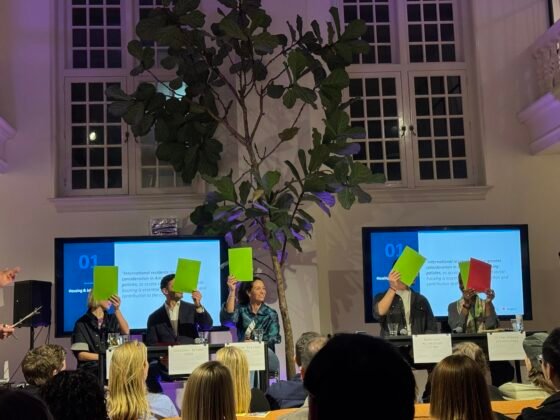
Housing was a major issue in the debate, with all parties acknowledging that internationals are subject to exploitation and fraud from unscrupulous landlords – they don’t have a parental home as a backup and often don’t know the rules.
Broersen, who has flat-shared with foreigners, said one friend was asked to pay €300 in cash for a house, which is illegal. Her party and the VVD have argued for more possibilities to flat share, to reduce the number of empty rooms and house more students and young people.
Bastiaan Minderhoud, for the PvdA – which will merge with GroenLinks after the election – said his party focuses on social housing and aims to provide accommodation for some 11,000 people without a fixed address.
“And that is because from the national government, there is no support to build social homes,” he said. “We’re asking ourselves the question, what kind of city do we want to be? And the answer to that is we want to remain a city where everybody can have a home. And that’s why we’re building 40% social, 40% middle [priced regulated homes], 20% [free] market.”
With waiting lists of 10 years for social homes, however, many internationals in the room pointed out that they were unlikely ever to qualify for this housing. This was a point stressed by Marianne Brackel, standing for the VVD, a centre-right party.
Yemane, councillor for GroenLinks, said the party wanted to tackle empty housing and had a strong ideological view that nobody should make money from property. “There are a lot of houses and offices that are empty right now: this is something that you can [tackle] actually as soon as possible,” she said. “And another thing I cannot stress enough is that we have to go back from the ‘money market.’ A house to live in should be a right, not for profit.”
She was the only councillor to put up a red card to partly disagree with the statement: “International residents deserve greater consideration in Amsterdam housing policies, as access to affordable and stable housing is essential for their inspiration and contribution to the city.”
Transport and safety
The debate also discussed transport, concerns about safety on the street – a Volt and VVD focus – and the large international student population, often struggling to find a room.
With a turnout of just 45% in the last local election and according to the FD, eight seats that could be decided by the international vote, more Amsterdam parties have translated their programmes into multiple languages.
Dutch News asked, however, why a recent book by Amsterdam Labour head and economic affairs chief Sofyan Mbarki took a less friendly tone towards internationals than the words on the podium.
“One of the things he said was, ‘Tens of thousands of partners are sitting at home without work while our labour market is crying out for their effort.’” Dutch News quoted from the book, But You’re a Good’Un.
“And he also said, foreigners should ‘do their bit without pulling away completely into your (academically educated) bubble because you think that you don’t need to contribute and that only the (poor) newcomer needs to step forward. That doesn’t feel super friendly to expats.”
“In the end, you’re here,” said Minderhoud. “You’re as much of an Amsterdammer as I am or anyone at this table, and I think that you have to deal with the same issues that we have to deal with, and you came here for the same reasons that we came here. I hope that if you are at home here, you vote with your heart.”